


Physical Symptoms of Anxiety You Might Be Ignoring
“The body often carries what the mind has not yet had the space to process.”
The importance of mental health in today’s world is often discussed in terms of thoughts and emotions — worry, overthinking, low mood, or stress. These are the aspects people tend to recognise first. The physical symptoms of anxiety are mostly hard to recognise.
Your brain is so occupied with the noise that you become unconscious of the signs your body is trying to give you.
What receives less attention is how often anxiety is experienced through the body.
For many individuals, anxiety does not initially present as a clear mental state. Instead, it may appear as physical discomforts that seem unrelated or difficult to explain. A tight chest without a known cause can be concerning. Persistent fatigue despite adequate sleep. Subtle but recurring sensations that are easy to dismiss or attribute to lifestyle, diet, or routine stress.
These experiences can feel disconnected from psychological processes. People may seek medical explanations, adjust habits, or ignore the symptoms altogether, assuming they will pass. And sometimes they do temporarily.
But often, the body is not malfunctioning. It is responding.
Understanding the importance of mental health in today’s world requires expanding the lens beyond thoughts and emotions to include these quieter physical signals. They often reflect the same underlying processes, expressed through a different channel.
This blog will help you understand the physical symptoms of anxiety that you should not ignore, because “Not every symptom is a signal of illness. Some are signals of overload.”
What Are the Physical Symptoms of Anxiety? (Quick Answer)
Physical symptoms of anxiety include chest tightness, fatigue, headaches, digestive issues, and muscle tension—even without obvious stress.
Why Anxiety Happens
1. The Nervous System’s Role in Anxiety
Anxiety is not purely a cognitive experience. It is related to the nervous system, especially stress response mechanisms of the body.
In the event that the brain senses a threat, be it immediate or abstract, it can trigger a physiological reaction that is aimed at getting the body ready to act. This may involve a rise in heart rate, alterations in breathing, muscle tension, and alertness.
This is an adaptive response in acute situations. It assists the body to react swiftly.
But in contemporary situations where stress can be chronic and less distinctly defined, the nervous system can continue to be partially activated over longer periods. This may result in physical feelings that even continue when there is no imminent threat. So you need to understand those physical symptoms of anxiety so that you can safeguard your mental health.
2. Chronic Low-Level Activation
Not all individuals feel anxious, but rather a low level of continuous activation.
This condition is not necessarily panic. It may feel like
- A constant background tension
- Subtle restlessness
- A feeling of incomplete body relaxation.
This level can be become accustomed to with time. The body becomes accustomed to operating in it, and the sensations become less evident, yet they exist.
3. Emotional Processing and the Body
Not every emotional experience is processed in real time.
Pressure, uncertainty, or interpersonal difficulty situations can be put aside to proceed with functioning. But the physiological reactions that come with such experiences do not necessarily work out so fast.
The body might still be retaining some element of that activation, despite the conscious mind having passed on.
This may add to physical symptoms that seem not to relate to any prevailing emotional condition.
4. The Mind-Body Feedback Loop
There is often a feedback loop between physical sensations and cognitive interpretation.
A physical symptom (tight chest or rapid heartbeat) can be considered a possible issue. This interpretation is able to enhance vigilance, which consequently enhances the physical response.
This loop will be able to maintain both the physical and cognitive experiences over time, even without an obvious external stimulus.
To know more, read – Why Your Mind Won’t Quiet Down (Constant Anxiety & Mental Buzz Explained)
Medical & Psychological Insights
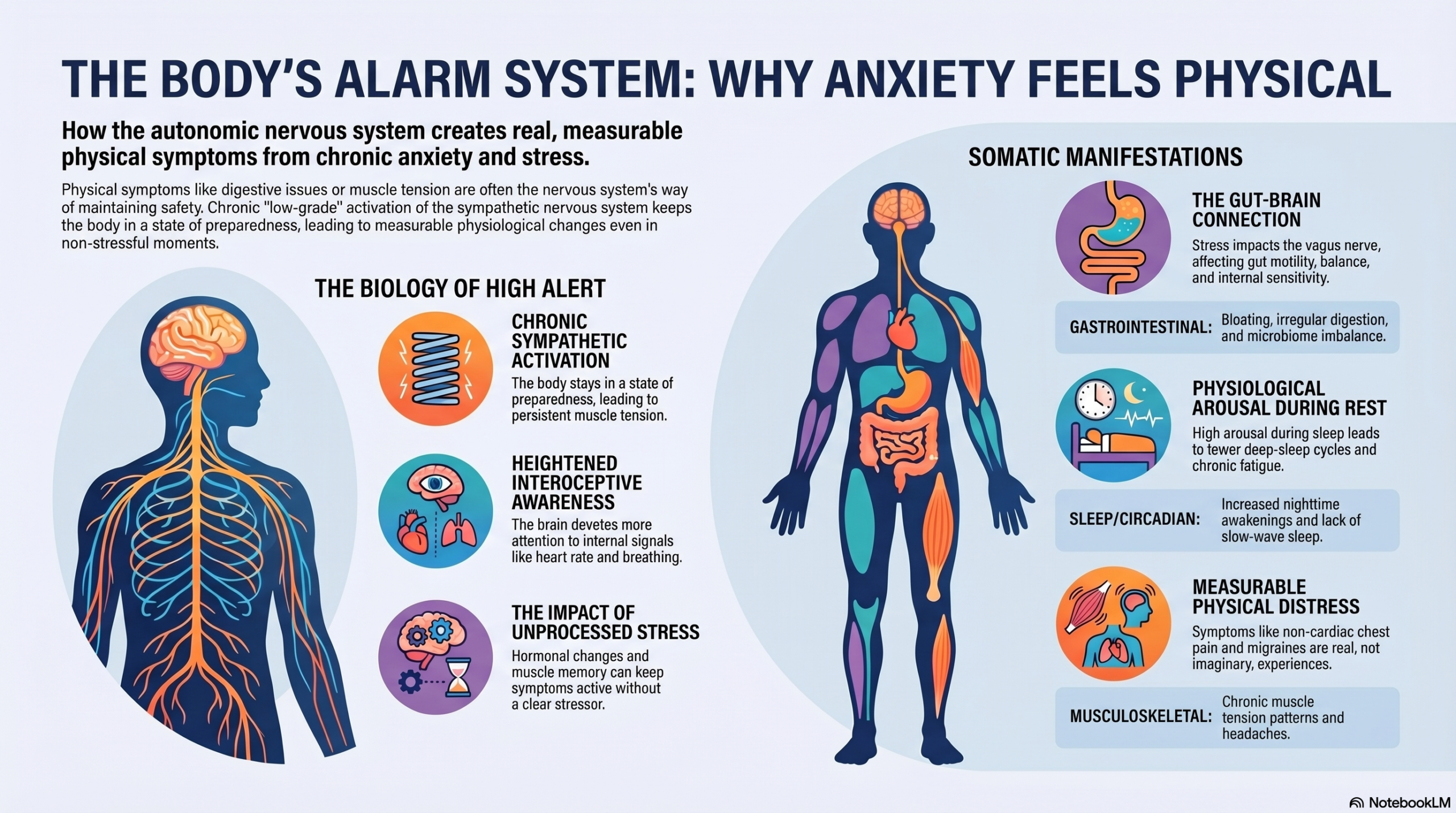
“What feels like a physical problem can sometimes be the nervous system trying to maintain a sense of safety.”
1. The Autonomic Nervous System and Chronic Activation
The autonomic nervous system, especially the sympathetic (activation) and parasympathetic (rest) systems, can be considered the key to anxiety. Studies indicate that a large number of people with persistent anxiety are undergoing some sort of chronic low-grade sympathetic stimulation.
This does not always result in acute panic, but it may maintain the body in a state of preparedness.
In the long run, this can lead to:
- Elevated muscle tension
- Higher patterns of stress-related increased heart rate variability.
- Problems with changing to restful states.
This is one of the reasons why certain individuals experience on edge even in non-stressful circumstances.
2. Somatic Symptoms and Anxiety
Somatic symptoms of anxiety are commonly described in clinical literature, in which psychological distress manifests itself physically.
Common findings include:
- Gastrointestinal problems (associated with the gut-brain axis)
- Headaches and migraines
- Pain in muscles and chronic tension.
- Non-cardiac chest pain
These symptoms are not imaginary but actual and measurable experiences and are mediated by the manner in which the brain and the body interact.
3. The Gut–Brain Connection
The gut and the brain are interrelated with the help of the vagus nerve and biochemical signalling.
Stress and anxiety may impact:
- Gut motility (with resultant discomfort, bloating, or irregular digestion)
- Microbiome balance
- Responsiveness to internal sensations.
That is why most individuals with anxiety complain of digestive symptoms despite the absence of an evident dietary cause.
4. Hypersensitivity to Body Sensations.
Others become interoceptively aware, that is, more sensitive to internal bodily signals.
This can lead to:
- Being able to see slight variations in heart rate or breathing.
- Heightened sensitivity to small pains.
- Enhancement of sensations by concentration of attention.
This does not imply that the symptoms are being overemphasised, but it does mean that the brain is devoting more attention to them, which can enhance the experience.
5. Physiological Arousal and Sleep Disruption.
Although people may not be consciously anxious, research indicates that physiological arousal may be high even when one is resting.
This may lead to:
- Less deep sleep (slow-wave sleep).
- Increased nighttime awakenings
- A sense of not restful sleep.
This goes hand in hand with complaints of feeling fatigued even after a sufficient sleep period.
6. The Impact of Unprocessed Stress.
Psychological studies indicate that unprocessed or long-term stress might not be resolved completely at a cognitive level.
Rather, it can be active in the body by:
- Chronic tension patterns (muscle memory).
- Hormonal changes (increased cortisol with time)
- The frequent stimulation of stress pathways.
This can be used to explain why physical symptoms can continue to exist even in the absence of the stressor.
6. When should you consider getting a medical exam?
Although anxiety may be a cause of physical symptoms, one should not suppose that all the symptoms are psychological.
The medical assessment can be suitable in the following cases:
- Symptoms are new, severe, or worsening
- There are risk factors for underlying conditions
- Physical changes are abrupt and out of context.
A moderate stance usually means considering both the medical and psychological perspectives rather than pitting one against the other.
To know more, read – Why Your Mind Won’t Slow Down (Even When Nothing Is Wrong) – Explained
Physical Symptoms of Anxiety (How It Shows Up in Daily Life)
1. Subtle and Persistent Physical Sensations
Anxiety can manifest itself physically in such a manner that it is easy to ignore:
- Mild and intermittent chest tightness.
- Regular headaches or tension on the sides of the head.
- Abdominal pain with no apparent aetiology.
- Tension in muscles, especially in the shoulders, neck, or jaw.
These symptoms, individually, might appear insignificant. Collectively, they are able to establish a threshold of distress that influences general health.
2. Changes in Breathing Patterns
Altered breathing is common to many people without their awareness.
This can include:
- Shallow breathing
- Seldom breathing in or out.
- A sense of not receiving sufficient air, even when oxygen is normal.
These trends may contribute to feelings of discomfort or exhaustion.
3. Fatigue That Feels Disproportionate
Constant low-level activation may be physically taxing.
The body can even be in a state of preparedness, even without strenuous activity. This may eventually lead to fatigue that rest cannot completely relieve. This can be said to be a feeling of being exhausted and wired.
4. Sleep Disturbances
Sleep may be influenced in minor ways:
- Problem with falling asleep because of physical restlessness.
- Light sleep that does not seem to be restorative.
- Waking up with tension in the body.
The quality of sleep may seem to be impaired even when the duration of sleep seems to be adequate.
5. Impact on Daily Functioning
Such physical experiences may affect everyday life in not-so-obvious ways:
- Lack of concentration because of discomfort or tiredness.
- Increased irritability
- Shy to avoid circumstances that can increase physical sensations.
The effects might be misinterpreted or downplayed because the symptoms are not necessarily distinctly associated with anxiety.
Subtle Consequences Over Time
“Anxiety does not always arrive as fear. It may appear as tension, fatigue, or a body that does not fully settle.”
1. Normalisation of Discomfort
Physical symptoms can be normalised when they continue to occur over time.
Individuals can start to believe that:
- Constant tension is typical
- Fatigue is unavoidable
- Suffering is just a normal way of life.
This normalisation may postpone the identification of the underlying cause.
2. Increased Health Anxiety
Physical symptoms that do not have an explanation cause one to worry about the possibility of some underlying medical condition.
Although medical assessment is crucial, repetitive reassurance without a resolution may occasionally amplify attention to body sensations, further supporting the loop of awareness and concern.
3. Reduced Emotional Awareness
Emotional awareness can be less evident when anxiety is felt mostly in the body.
People can work on physical symptoms without being aware of the emotional background behind them.
This may complicate the process of pattern or trigger identification.
4. Gradual Withdrawal
In the long run, chronic pain may affect behaviour.
Individuals can start to:
- Avoid certain activities
- Limit physical exertion
- Withdraw from social situations
Not necessarily because of fear, but because of the constant existence of physical discomfort.
5. Identity Shifts
Long-term physical symptoms may be subtle in impacting self-perception.
Phrases like I am always tired or my body does not feel right can become a part of self-perception, although the underlying cause is not completely understood.
How to Deal with Anxiety (Simple Steps)
1. Recognising the Mind-Body Connection
The first change could be the consideration that psychological processes can be attributed to physical symptoms.
This does not nullify the physical experience. Instead, it expands the knowledge of what could be causing it.
2. Bringing Awareness to the Body
It can be helpful to observe physical sensations and not immediately attempt to alter them.
This may include:
- Noting where tension is stored.
- Learning to be conscious of breathing.
- Being able to identify physical condition changes during the day.
This sensitivity can eventually diminish automatic reactivity.
3. Allowing Space for Emotional Processing
Unprocessed emotional experiences can sometimes be manifested physically.
This can be facilitated by creating space to contemplate, whether through writing, talking, or silent observation.
Not all emotions need immediate resolution. Recognition is in itself a big thing.
4. Adjusting Cognitive Load
The decreased continuous mental input can affect physical conditions.
This does not entail radical changes. Even minor changes in the ways information is taken in and processed can leave room in the nervous system to rest.
5. Considering Professional Support
In case of persistent or distressing physical symptoms, professional advice may be used to investigate the physiological and psychological aspects.
The methods that combine mind-body approaches can be especially applicable.
Personal Reflection Segment
I had a period when I concentrated near-completely on what I could observe -performance, strength, progress.
When my body was tight, I thought that it had to be stretched further.
When I was fatigued, I thought that I had not trained sufficiently.
When something was off, I took it as a challenge to fight.
It was a long time before I realised that my body was not merely responding to exertion.
I had times when I was doing everything right on the surface, training regularly and working towards goals, and something underneath did not sit well. Even during rest, my shoulders were tight. I did not feel like I had slept. I felt the internal pressure all the time, which was not in line with the situation.
Initially, I attempted to make it happen physically.
More discipline. More structure. More control.
However, the harder I attempted to suppress it, the more it recurred.
In hindsight, not all of those feelings were indications of frailty or indifference. They were reactions to pressures I had internalised, to expectations I had internalised, to experiences I had not necessarily digested when I was in the situation.
I had learned to just continue, but I did not always have to pay attention to what remained of my body due to being in that condition.
The change was not achieved through a solution.
It arose out of the realisation that my body was not independent of what was going on in my mind. The strain, the weariness, the impatience, they were not accidental.
They belonged to the same trend.
Realising this did not instantly alter my feelings.
But it made me think of it differently.
Key Takeaways
- Anxiety is a bodily experience rather than a thought and emotional experience.
- Physical manifestations can be tension, fatigue, digestive problems, and changes in breathing.
- Over time, the nervous system can be left in a low-level state of activity.
- Raw emotional experiences may add to the continued physical experiences.
- The symptoms are normalised and can be easily missed.
- Understanding of the mind-body relationship can change the perception of the symptoms.
- The way to deal with these experiences is to understand them, rather than correcting them immediately.
Frequently Asked Questions
Is it true that anxiety can have physical symptoms?
Yes. Anxiety is a process that can have physiological effects on various parts of the body, such as cardiovascular, muscular, and digestive functions.
Why is my illness physical and not emotional?
Some people feel anxious more by physical feelings than by emotional consciousness. This may be affected by the processing and expression of emotions.
What can I do to know whether my symptoms are anxiety or something medical?
A healthcare expert should be consulted to eliminate medical conditions. In case there is no obvious physical cause, it is possible to take into account psychological factors as part of the whole picture.
Why should these symptoms continue even when I am calm?
Even in the absence of a stressor, the nervous system can be left in an activated state. This may lead to a continuation of physical sensations even though the mind may be calm.
Are these symptoms curable?
They can evolve over time, particularly when the underlying patterns are known and dealt with. It is usually not instantaneous but a gradual process.
Closing
“The body often speaks in ways the mind has not yet learned to understand.”
The significance of mental health in the current world is frequently addressed with the help of apparent distress, which may be called, diagnosed, or expressed. But a lot of the experience is less noisy than that.
It can be in the body, and then it can be realised in thought.
It might exist as stress before its interpretation as anxiety.
It can be experienced as something uncomfortable and does not have a definite story behind it.
These do not exist independently of mental health. It is theirs.
What seems to be a physical nuisance in most instances is a larger trend – a nervous system that has grown accustomed to constant strain, a mind that still operates even when unconscious, and a body that bears what is yet to be fully recognised.
There is no urgency or need for correction to understand this. It must be attended to, not coerced, but slowly. The type which enables patterns to be seen as time goes by.
The aim of Remnival is not to streamline these experiences or transform them into solutions. It is to remain with them long enough to know their form, how they grow, how they endure, how they are inhabited within.
Since the significance of mental health in the modern world is not only what is loud enough to be discussed but also what is quiet, constant, and often unnoticed, waiting, in its turn, to be comprehended.
Gentle Disclaimer
The article is only intended to be educational and reflective. It cannot be used in place of professional medical or mental health advice. In case of any continued or alarming symptoms, it is advisable to seek the assistance of a health practitioner.