

Why Your Brain Replays Conversations at Night: Understanding Nighttime Overthinking and Anxiety
Have you ever thought of why your brain replays conversations at night, mostly when you try to fall asleep?
The main reason behind this is the anxiety in your brain that you try to suppress.
So what is anxiety then?
Anxiety is actually a state that comes when you have emotional turmoil in your brain, which typically involves feelings of fear, dread, and uneasiness.
When you just sit with a thought for too long and go beyond overthinking, then your brain prepares you for the consequences unknowingly.
Then you start to experience anxiety.
The simple difference between overthinking and anxiety is that if you are experiencing only thought loops, that is overthinking, but if you are having thought loops and physical unease, like a tight chest, breathlessness, shaky hands, and a racing heart, that is anxiety, which is not good for your mental health.
To know in detail, read: What Is the Difference Between Thinking and Overthinking?
So still we are at the same question: why your brain replay conversations at night?
There is no immediate short answer, but the most logical answer is that at night there are fewer distractions in your brain as compared to the day.
So when the distractions of the day vanish, leaving your mind with more “space” to process unresolved worries.
Why Do I Replay Conversations at Night? (Quick Answer)
Replaying conversations at night is often caused by overthinking, unresolved emotions, and the brain trying to process social interactions when everything becomes quiet.
Why This Happens?
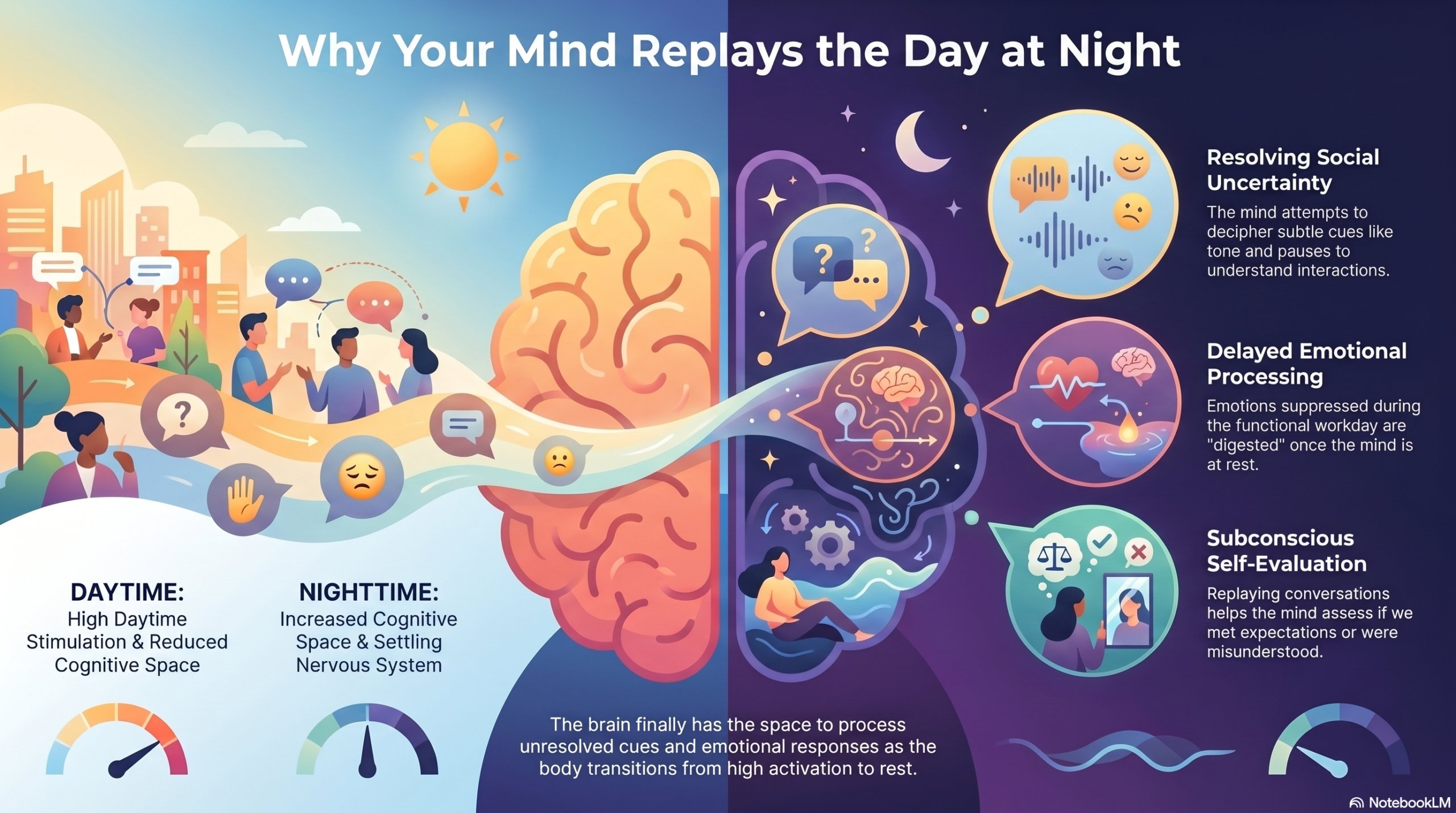
1. The Mind’s Attempt to Resolve Social Uncertainty
Human interaction often involves a certain degree of ambiguity that is not necessarily resolved at the moment.
Discussions usually include tone, pauses, phrases, and other subtle cues that we might not immediately comprehend. Subsequently, when the environment is less active, the mind can go back to these moments to decipher what they entailed.
This is not necessarily a flaw. It belongs to the functioning of social cognition, an effort to comprehend how one is viewed, whether one has overlooked something, or whether a circumstance needs to be altered.
But when these questions go unanswered, the mind keeps going back to them and receives no answers.
2. Reduced Distraction and Increased Cognitive Space
When it comes to daytime, the focus is on the outside world, work, communication, and obligations. This restrains the ability of the mind to ruminate about unresolved experiences.
This structure varies at night.
Outward stimulation is reduced, and cognitive space is increased. Previously suppressed or deferred thoughts can become more available. These thoughts are not produced by the lack of distraction, but it enables them to be more prominent.
3. Emotional Processing Delayed by Functioning
A lot of individuals go about their day in a functional state.
People do not give much attention to emotional responses, especially in brief. An awkward comment, a moment of hesitation, or a perceived error can be put aside to keep operating.
Subsequently, at the end of the day, the mind can revisit these moments to digest what was not fully felt in the previous moments.
This may add to the feeling that thoughts are appearing at night when, in fact, they were there all day and were not attended to.
4. The Role of Self-Evaluation
The replaying of conversations is usually associated with the way people assess themselves.
There may be an underlying concern about:
- Speaking out of place.
- Being misunderstood
- Not meeting expectations
- Looking weak or not consistent.
Such concerns are not necessarily at a conscious level, yet they may influence the way of remembering and reviewing interactions.
By doing so, the mind is not just remembering events. It is assessing them.
5. A Nervous System That Has Not Fully Settled
The body can still be in a mild state of activation even after the day is over.
When the nervous system has been stimulated during the day, whether by stress, decision-making, or socialisation, it might take time to get into a restful state.
This transition may involve high mental activity. The thoughts can keep on moving, not due to urgency, but because the system has not settled yet.
How It Shows Up in Daily Life?
1. Repetitive Thought Loops
Repetition is the most prominent characteristic.
The identical dialogue can be repeated several times, usually with minor variations:
Restating what has been said.
Imagining alternative responses
This gives the other person a different interpretation.
These loops rarely have a definite conclusion. Rather, they like to revisit the same questions.
2. Heightened Awareness of Social Interactions
People who are affected by this pattern might be more conscious of their perception during the day.
This can include:
- Observing wording and tone keenly.
- Observing changes in the reactions of others.
- Looking back at what has been said immediately after.
This consciousness does not necessarily manifest itself outwardly, but it may also lead to internal exhaustion.
3. Problem with falling asleep
Overthinking at night usually disrupts the process of sleeping.
The mind can be active even when one is physically exhausted. The thoughts can be carried on in the background, and it is hard to completely disengage.
This situation can lead to:
- Delayed sleep onset
- Light or interrupted sleep.
- Feeling unrested when one wakes up.
4. Emotional Turmoil
Although the thoughts themselves can be neutral or analytical, they are frequently supported by some emotional undertones:
- Mild regret
- Uncertainty
- Self-doubt
- Lingering discomfort
Such feelings are not necessarily intense, but their continuity adds to the experience.
5. Impact on Presence
In the long run, this trend can influence the way people live in the present.
Conversations can be a bit split apart; some part of the attention is outward, some inward, doing an assessment. This may diminish the feeling of comfort in interpersonal relationships.
To know more, read: Physical Symptoms of Anxiety You Might Be Ignoring
Subtle Consequences Over Time
1. Mental Fatigue
The thought process of monotony is consuming.
The thoughts can be small but when they are piled up, they can result in mental fatigue. This may not always be as a result of overthinking but it can influence overall level of energy.
2. Increased Self-Consciousness
A re-evaluation of the past can enhance self-awareness in a way that is not always healthy.
It may cause people to become more cautious in their future communication, and it may make the interactions less natural.
3. Avoidance of Social Situations.
The suffering of re-enacting conversations may in some cases lead to the avoidance subtly.
This may not be deliberate. It can appear as:
- Preferring fewer interactions
- Limiting the participation in discussions.
- Timid in social situations.
4. Restatement of Thinking Patterns.
The brain reinforces the pattern whenever a conversation is repeated.
In the long run, it can be more automatic and less consciously initiated.
5. Shifts in Self-Perception
Individuals can begin to identify themselves as someone who overthinks or someone who plays everything over and over.
Although these descriptions might seem true, they can also cement the trend as a part of identity, but not something that can be comprehended and observed.
How to Manage it? (Simple Steps)
1. Scheduled “Worry Time”
Find 15 minutes at the beginning of the day to list your worries and how you might resolve them. This is an indication to your brain that the problem-solving is already completed today.
2. The 15-Minute Rule
When you are unable to fall asleep after 15-20 minutes, get out of bed. Move to another room that has low light and perform something relaxing (such as reading) until you feel sleepy once again. This will not allow your brain to relate your bed to stress.
3. Physical Grounding
Practice methods, such as progressive muscle relaxation (tensing and releasing muscles in a systematic way) or the 5-4-3-2-1 technique, to refocus your attention on your body, rather than your thoughts.
4. Limit Stimulants
Stimulants such as caffeine can be avoided after mid-afternoon, and screen time should be limited an hour before bed, since blue light interferes with sleeping hormones.
5. Considering Professional Support
Once this trend becomes chronic or uncomfortable, professional assistance can provide a platform to discuss underlying issues regarding self-judgment, social phobia, or emotional regulation.
Frequently Asked Questions
1. Why do I repeat talks at night?
This is usually the case since the mind during the night has more cognitive space to process interactions that were not well comprehended during the day.
2. Is it a kind of anxiety?
It may be linked to anxiety, especially social or generalised anxiety, but it is not necessarily a sign of a clinical condition.
3. What is the reason why it occurs more at night than during the day?
There are fewer distractions at night, and thoughts that were repressed or delayed in the past come into the limelight.
4. Is this able to influence the quality of sleep?
Yes. It may be harder to find restful sleep, even when the body is exhausted, because of continuous mental activity.
5. Is it experienced by all?
A lot of individuals have some degree of nighttime introspection. The distinction is usually in the frequency, intensity, and extent of interference with rest.
Closing
“The mind always returns to those thoughts that felt incomplete, not necessarily to solve them, but to make sense of them.”
To wrap things up, remember that nighttime anxiety isn’t a sign of weakness; it’s often just a sign that your brain is trying to protect you by “solving” things when the world goes quiet.
It is not just an overthinking habit to replay conversations at night. It can be a sign of how the mind works with uncertainty, how it stores social experiences, and how it tries to arrange what it did not understand at the time.
The main thing is understanding the problems, rather than trying to resolve those.
At Remnival, what you will found ass to see this as emotions, and you will know how to regulate those emotions rather than trying to control those emotions.
“Finish each day and be done with it. You have done what you could. Some blunders and absurdities no doubt crept in; forget them as soon as you can. Tomorrow is a new day.”
— Ralph Waldo Emerson
Gentle Disclaimer
The article is aimed at education and thinking. It is not a substitute for professional mental health care.
In case you are in constant distress or trouble, it can be beneficial to consult a mental health specialist.