


Why Your Mind Won’t Quiet Down?
Have you ever wondered why your mind won’t quiet down when nothing is actually wrong?
Ever felt the bombardment of thoughts in your brain when you are just trying to sit peacefully? If yes, this is often a sign of underlying anxiety.
If you’ve ever wondered why your mind won’t quiet down even when nothing is wrong, you’re not alone.
Anxiety is supposed to be intense. Something noticeable. A racing heart. A distinct attack of panic. It reaches a point where it takes over your mind, and your mind won’t quiet down.
But there is also another type of anxiety, which doesn’t fully leave your mind. It stays. Not loudly. Not dramatically. Just… consistently pushing our brains to think of all the negative outcomes.
It is a sense of activity in the mind. Thoughts that don’t settle. A sense of movement that doesn’t stop when nothing specific moves it.
It might feel like an undercurrent, not so much that it paralyses you but certainly that it makes you feel drowsy.
You can still function.
You go to work. You talk to people. You do things. On the surface, all is well just outside. From the inside, internally, it can feel like your mind never fully settles.
Even when you’re not doing anything, something is still happening:
- it often shows up as constant mental activity
- A subtle tension in the body
- A sense that something needs to be done
This experience can be hard to articulate over time.
Because there is no obvious problem. But the mind appears to be busy.
This feeling can be misinterpreted. It mightn’t even be identified as anxiety. It might be called overthinking, fidgetiness, or even “normal.”
But this steady chatter can be a type of anxiety that’s become chronic, and your thoughts don’t settle.
And because it is steady, it can be more difficult to detect and to break away from.
In this blog, we will discuss the same problem of why your mind won’t quiet down, why it is unable to settle down, and why you have thoughts out of your control.
Why Your Mind Won’t Quiet Down (Quick Answer)
A constantly active mind is often caused by low-level anxiety, an overactive nervous system, and repeated thought patterns, not just stress or overthinking.
When anxiety is experienced as a consistent mental buzz, it often shows up as constant mental activity, slight tension, and inability to fully experience mental calmness, even in the absence of an obvious problem or immediate stressor.
It can be accompanied by unremitting thoughts, low-grade anxiety, and internal restlessness during the day.
You can read more on Why Your Mind Won’t Slow Down (Even When Nothing Is Wrong) – Explained
Why Your Mind Won't Quiet Down (Psychological Explanation)
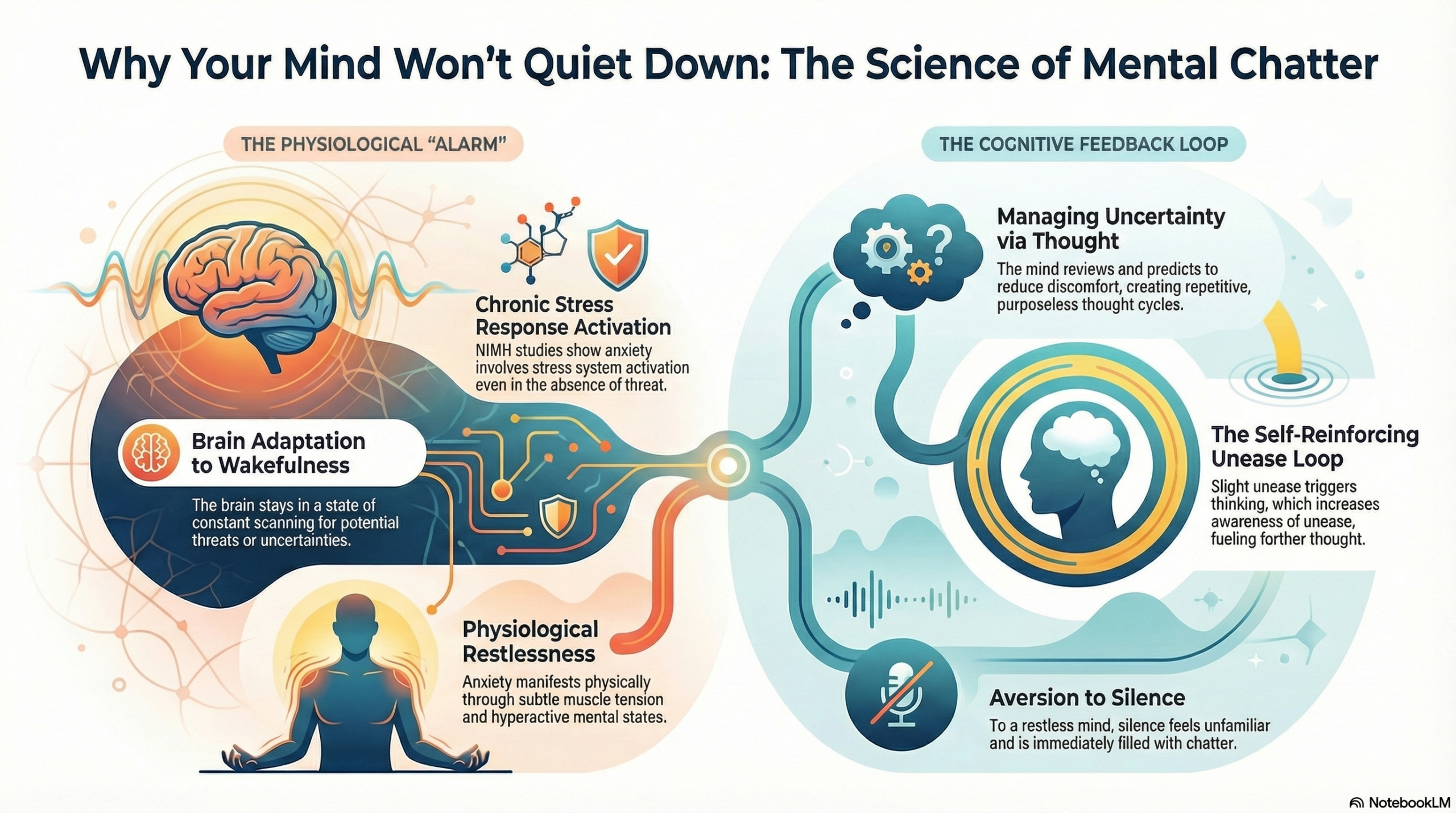
1. Brain Adapts to a State of Slight Wakefulness
Your brain is designed to stay alert to changes and potential threats.
It’s always looking out for changes, threats, or uncertainties.
Under sustained stress or pressure, this scanning can increase and then become continuous.
Rather than switching on only when a threat is present, the brain is constantly scanning.
Not panic. Just readiness.
This leads to constant mental chatter.
2. The Nervous System Doesn’t Fully Settle
Anxiety is both mental and physiological.
The nervous system is involved.
If the system is not fully shut down, even in the absence of stress, the body still “sounds” the alarm:
- Subtle muscle tension
- Increased mental activity
- Restlessness
A study cited by the National Institute of Mental Health Research shows that chronic anxiety can keep the brain in a constant state of alertness, even without an immediate threat.
This results in hyperactivity of the mind.
3. Thoughts Become a Way to Manage Uncertainty
The mind tends to reduce discomfort through thinking.
When something feels unclear, your mind starts to:
- Review possibilities
- Predict outcomes
- Analyze scenarios
However, if the discomfort is unclear, thinking does not resolve it.
It continues.
This leads to the experience of:
- Thoughts without a clear purpose
- Repetition without resolution
Which contributes to the “buzz.”
4. Cognitive Loops Reinforce Themselves
The brain gets used to thinking and begins to expect it.
This is a loop:
- Slight unease → thinking
- Thinking → more awareness of unease
- More awareness → more thinking
And it goes on and on.
5. Silence Feels Unfamiliar
With a continuous stream of thought, your mind rarely experiences true silence or calm.
It is not always uncomfortable, but it is certainly strange.
So your mind tries to fill that silence.
Even when we don’t want to.
Signs of Constant Anxiety in Daily Life
1. Thought Patterns
The constant presence of thought is usually the most apparent.
Not necessarily distressing or dramatic thoughts, but constant ones:
- Did I handle that correctly?
- What if something goes wrong later?
- I should double-check that.
- I need to think through this again.
These thoughts can be manageable in a single instance, but since they are constant, they cause exhaustion, and that is why your mind won’t quiet down.
2. Difficulty Experiencing Full Rest
The mind can also be busy even during downtime.
Sitting and watching a show, or sitting and lying in bed, may not give total mental calmness.
A subtle feeling of unfinished business may exist even when there is nothing urgent that needs to be taken care of.
Your mind may only partially relax, not fully reset, and your mental health will deteriorate day by day.
3. Physical Sensations
Such constant intellectual action is frequently supplemented by physical tension of a low grade:
- Mild chest or shoulder tightness.
- Shallow breathing.
- Jaw tension
- It is a sense of internal restlessness or impatience
Such sensations might not be strong enough to attract attention alone, but they lead to the overall feeling of unease.
4. Impact on Sleep
Sleep is often impaired.
The silence of the night may enhance the buzz in the head.
The things that could be handled in the daytime might be more apparent when one is not distracted.
This may result in:
- Problems with sleeping.
- Frequent waking
- Light, non-restorative sleep.
Although the duration of sleep may seem sufficient, the quality may be perceived to be impaired.
5. Subtle Effects on Relationships
It is also this internal condition that may affect the way individuals associate with others.
- Internal thoughts may be used to filter conversations to some extent.
- It is possible to overanalyse interactions afterwards.
- Even during meaningful moments, emotional presence may seem a little diminished.
It results from the separation of attention between the outside and the inside stream of thought, not from a lack of caring.
You can read more on The Difference Between Thinking and Overthinking (With Clear Examples)
Long-Term Effects of Constant Anxiety?
If this trend persists for weeks or months, its impacts may become more pronounced, and it can be visible in your mental health.
1. Mental Fatigue
The brain uses energy in constant cognitive activity.
Although every single thought might appear small, when combined, they can cause persistent fatigue.
This is not always alleviated through sleep, since the underlying pattern is active.
2. Unable to Focus Deeply
The ability to sustain attention may be problematic.
The mind that is used to scanning and switching might not be able to stay with one task longer. This may affect work, reading, and creative thinking because your mind will never quiet down.
3. Gradual Emotional Blunting
With time, the emotional experiences might be less intense due to the continuous background activity.
Not dramatically, but gradually:
- Joy can be less immersive.
- Peace can be unsatisfactory.
- Contentment can be a transient state.
The nervous system, which is not always at rest, cannot permit more profound emotional states to appear.
4. Increased Avoidance of Stillness
Even stillness can start getting uneasy.
The mental buzz can be heightened by moments when one is not distracted, and one will want to be constantly occupied, checking the phone, reading material, or being busy.
This is also able to strengthen the cycle, since the mind is given fewer chances to naturally settle.
5. Shifts in Self-Perception
In time, people can start viewing this condition as their identity.
I am simply a person who thinks too much.
My brain does not rest.
Although these statements might be correct, they can also restrict the chances of knowing the mechanisms behind them and reacting in a different way.
How to Deal with Constant Anxiety (Simple Steps)
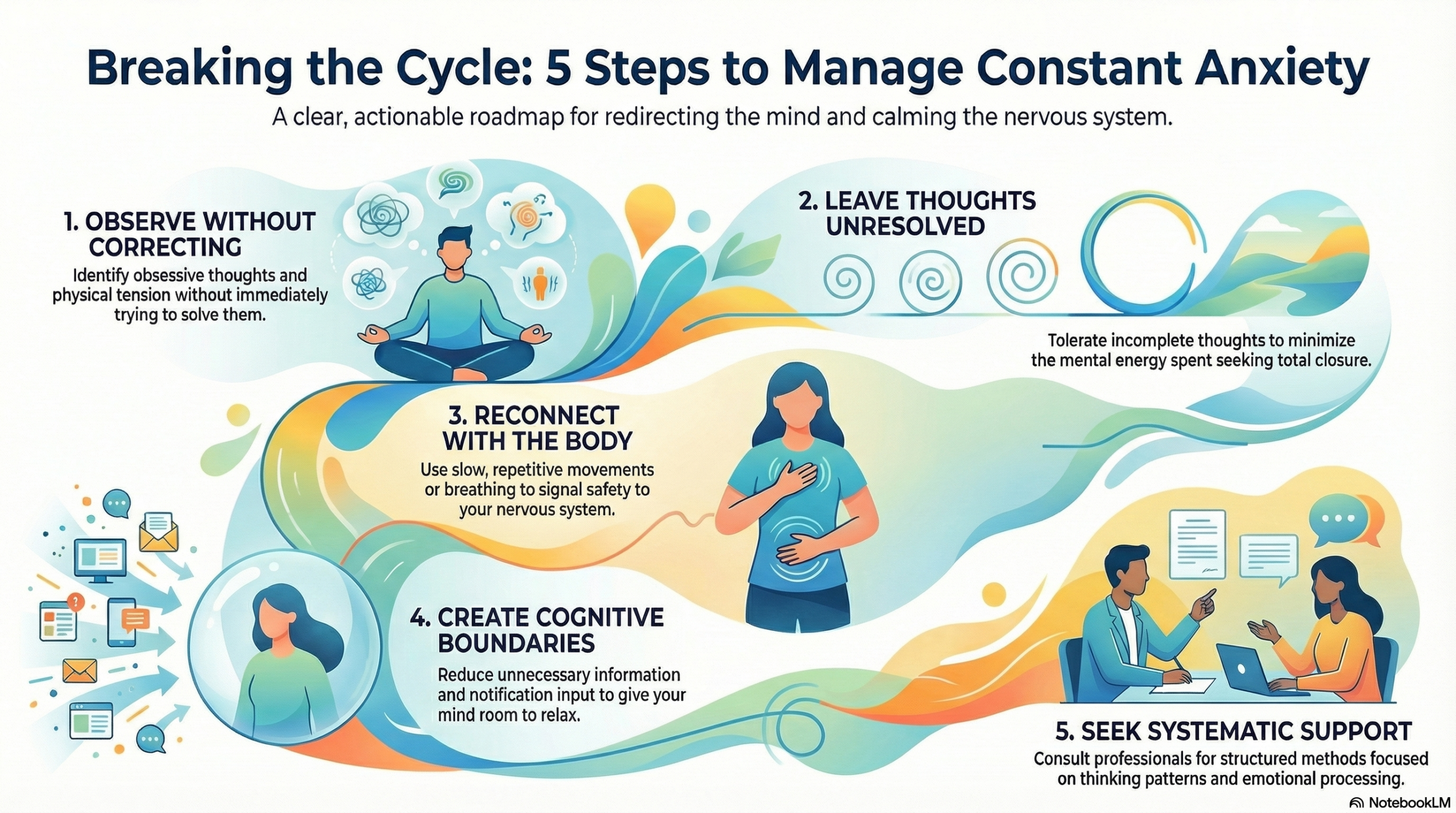
The solution to this experience is not to shut down the mind or thoughts but to give it redirection.
1. Noticing Without Immediate Correction
Among the initial changes is the mere observation of mental activity, without attempting to solve it at once.
This may involve identification of:
- Existence of obsessive thoughts.
- The slight tension in the body.
- It is the urge to figure out something.
This realisation, though easy, can begin to break the automatic pattern.
2. Allowing Unresolved Thoughts to Remain Unresolved
In this state, many of the thoughts are an effort to come to closure.
It can be better to leave some of these thoughts incomplete, without trying to decide, and tolerate this state of affairs, thus minimising the processing one has to carry out.
This can be awkward at first, particularly to the individual who is used to settling issues mentally.
3. Reconnecting With the Body.
Since this experience is partly physiological, body attention can be applicable.
This does not involve organised practices. It can entail:
- Observation of breathing patterns.
- Developing sensitivity to physical tension.
- Performing repetitive movements (slowly and repetitively, e.g. walking).
Such minor changes can communicate to the nervous system that one does not need to be constantly on high alert.
4. Creating Boundaries Around Cognitive Load
The contemporary world tends to feed one with constant stimuli – information, notifications, and decisions.
Any reduction in unnecessary cognitive load can leave some room for the mind to relax.
This does not have much to do with strict rules but rather with being aware of the amount of input that the mind is taking at a particular time.
5. Considering Professional Support
When the pattern seems relentless or incomprehensible, professional assistance can provide a systematic method of seeking it.
Treatment methods based on thinking patterns, emotional processing, and control of the nervous system can be of particular interest.
Personal Reflection Segment
Your feeling about why your mind won’t shut down is shared by others.
The noise in my mind did not start as an obvious feeling of anxiety.
It started as a necessity: being prepared.
I had grown up in a place where I wasn’t always exposed to obvious hardship. Not necessarily said, but experienced.
I was loved at home; outdoors, it was otherwise. I used to be smaller, younger, and less physically able than those around me.
So the people in my surroundings I was trying to fit in with were outmatched in strength, size, and roughness, and I understood that hard work did not necessarily result in safety.
In childhood, I started school early, and most of my classmates were older than I was. I remember in my first annual sports competition in standard 1, I ran first with a normal group. In the quarterfinals, I was first; in the semifinals, I was first again, but in the final, I ran with a stronger group.
In the final, I came in 6th. They didn’t give me the prize, and because I was so unaware of the events, I cried at home and said the teachers had given it to others, even though I had become 1st twice.
Even my father came to school the next day to ask my teachers about this. Then he learned everything and explained it to me.
From next year onwards, I was so competitive in my head that I used to practice more.
Gradually, that confusion became something different.
A sort of internal pressure not to allow things to occur again without being ready.
I began to treat everything as a competition, not necessarily outwardly, but inwardly.
Friends became competitors. Situations became tests. Even small moments carried a sense of evaluation:
Did I handle that well?
Could I have done better?
What if it happens again?
The mentality was not turned off. It grew.
It was further strengthened in boarding school. The building, the training, the physical demands – it was a place where being weak is not an option for survival.
I recall that I could not even do one push-up in front of others. It wasn’t just embarrassment. I still remember it when the time was over.
So I practised. Quietly, repeatedly. Day after day.
And I improved.
But along with that improvement came a feeling that I must always be ahead of my former self.
Everything followed me with that belief.
Even in the way I coped with pain.
There was a time when I was not aware of how to explain what I was feeling. The stress, the tension, the misunderstanding, it lacked a definite release.
So I attempted to cope with it in a manner that at the moment seemed like control. In retrospect, it was less about strength than coping with something I had yet to grasp.
The external pressure shifted as life progressed, including studies, career confusion, financial pressure, and relationships. But within, the trend was the same.
Always thinking ahead.
Always attempting to fix, control, and anticipate.
The mind was hardly at rest, even during the time I was working towards something meaningful, such as preparing to join the army, getting up early in the morning, and pushing my body to the limit.
The effort was always accompanied by another layer of thought.
But what if the information is not sufficient?
What will happen in case of another failure?
What am I missing?
And when things did not work as they should – when efforts failed, when relationships failed, when the body itself started to falter – the noise within increased.
Not dramatically.
But in a steady, incessant manner.
There were periods when I was not able to identify myself. I had been a planner who persevered, and there were times when everything felt heavy, unfocused, and disconnected.
I remember the days when my mind could not rest and kept going back and forth between past regrets and future concerns.
One day, when I was alone and tired, I discovered a kind.
Even when nothing was going on at the moment. My brain was still on the alert in anticipation of something. My mind was disturbed, and I was having severe anxiety.
Like the rest, must have permission.
In retrospect, it is more understandable.
That buzz in the head was not accidental. It was constructed through time-through conditions in which I had to remain on my guard, through the things that had never been digested, and through an idea that preparedness was safety.
The mind had been taught to continue when it was no longer necessary.
That knowledge did not make it quiet.
Nevertheless, it altered my relationship with it.
But now, as the thoughts begin to overload, then the mind begins to scan, revisit, and anticipate; there is at least a part of me that is aware that it is not an urgent signal but a familiar pattern.
Something that used to guide me through challenging spaces.
Something that, in silent times, is still learning how to slow down.
Key Takeaways
- Anxiety is not necessarily manifested in dramatic episodes; it might be a buzzing of the mind at a low level.
- The experience usually has a nervous system which is slightly active.
- Persistent thought patterns can indicate surveillance, processing of uncertainty and partial emotional experience.
- The effects may involve mental exhaustion, lack of concentration, and emotional depth movement with time.
- Silence can be uncomfortable, which supports distraction and action.
- A reaction is not immediate correction or control.
- Mental looping can be minimized by letting some thoughts go unsolved.
- Professional assistance can be used to investigate underlying trends in a systematic manner.
Frequently Asked Questions
1. Why do I feel busy when nothing is wrong?
This experience may take place in case the nervous system is in a mildly activated state. Even when there is no problem at hand, the mind might still scan the area where the problem may be or the past, just in case.
2. Is this equivalent to overthinking?
It overlaps, but this experience is usually more extensive. It involves not just repetitive thinking but a constant feeling of mental activity that might not necessarily be conscious and deliberate.
3. Is it possible to do this without a state of anxiety disorder?
Yes. The pattern is experienced by many people without qualifying as a clinical condition. It may be associated with stress, lifestyle or pattern of thinking.
4. What is wrong at night?
Night minimises external stimuli, and internal action becomes more prominent. This time can also be used by the mind to process pending thoughts and feelings of the day.
Will this disappear naturally?
For others, it can be subject to change due to life circumstances. In other cases, it may continue without alterations in its perception or treatment. Subtle awareness and, where necessary, professional advice can shape its development.
Closing
The significance of mental health in the modern world is customarily approached through the lens of apparent stress and strain, which impacts work performance; anxiety, which disrupts the normal operations of everyday life; and depression, which becomes hard to hide. However, other, quieter experiences are usually not talked about.
One of them is a constant buzz in the mind.
It does not necessarily require it to be noticed in the most apparent ways. It enables life to go on; we fulfil our duties, we have conversations, and we continue with our habits.
But there may be, underneath that, a consistent undertow of action that influences the experience of rest, the flow of thought, the completeness of the experience of a moment.
This type of internal condition may even start to be normal in a world that hardly ever slows down. Constant stimulation, constant uncertainty, and constant, vague pressure to prepare and adapt may keep the mind active long after the external demands have subsided. As time passes by, the boundary between the required thinking and routine mental action may be hard to trace.
The meaning of this does not involve attempts to shut down the mind or eliminate anxiety. It is concerned with the realisation of the patterns that keep it alive, the nervous system’s tendency to stay on, the habit of the mind to scan, and the silent build-up of unresolved experiences.
When these patterns are observed more distinctly, the experience, per se, can start changing. Not immediately, and not entirely, but just enough to produce some little instances where the mind is not dominant, and presence is a little more available.
In Remnival, there is no emphasis on correcting these experiences or simplifying them into simplified explanations. It is upon knowing them, their complexity, their subtlety, and how they are formed through time.
Since in most instances, mental health is not determined by what is physically broken, but by what is silently going on under the skin, demanding attention.
Gentle Disclaimer
The article is only intended to be educational and reflective. It cannot be used in place of professional medical or mental health advice. In case of any continued or alarming symptoms, it is advisable to seek the assistance of a health practitioner.