Why Your Brain Replays Conversations at Night (And How to Stop It)
Why Your Brain Replays Conversations at Night: Understanding Nighttime Overthinking and Anxiety Have you ever thought of why your brain replays conversations at night, mostly
If you’ve ever wondered why you feel tired all the time even after rest, the answer isn’t always physical exhaustion. Sometimes it is mental.
Nowadays, people feeling tired all the time is often caused by mental overload, emotional stress, depression, and a constantly active nervous system, not just lack of sleep.
You must have asked yourself this question: Why Do I Feel Tired All the Time (Even After Rest)? Where am I draining all my energy to the point that I am in a constant state of fatigue?
This is a serious mental health problem that we are never able to find out.
It does not necessarily have to be associated with hard work. And there are days on which nothing especially challenging has occurred, no long working hours, no hard work, and no noticeable strain, and the body still feels heavy.
The mind is slowed down. Even a simple task seems a bit more difficult than before.
Sleep does not necessarily heal it.
You get up and cannot believe you have got enough sleep, and you still feel like something is not done. Not dramatically wrong. Just… not restored.
The fatigue is there, nearly without any noise, as though it did not go entirely away, and you just keep asking yourself again and again the same question: why do I feel tired all the time?
In the long run, this is hard to explain because it’s not that your body is tired; it’s actually your brain.
Since mental tiredness can be caused by an obvious reason, it is reasonable. But when it fails to do so, people usually start to doubt themselves in their place:
Am I not resting properly?
Why do I feel tired all the time, then?
Is something wrong with my mental health?
These are not the questions that usually result from curiosity. They have a cloud of doubt hanging over them.
Yet this form of continued exhaustion is hardly about want of discipline or industry.
More frequently, it is a manifestation of something less conspicuous, how the mind and body have been straining for a long time. Not necessarily dramatically. Not necessarily via blatant stress. Yet in little, little ways that build upon themselves.
Fatigue in that definition is not necessarily about what you have done.
It has something to do with what you have been carrying sometimes.
One can easily guess that exhaustion is caused by physical exercise – by doing too much, moving too much, or sleeping insufficiently.
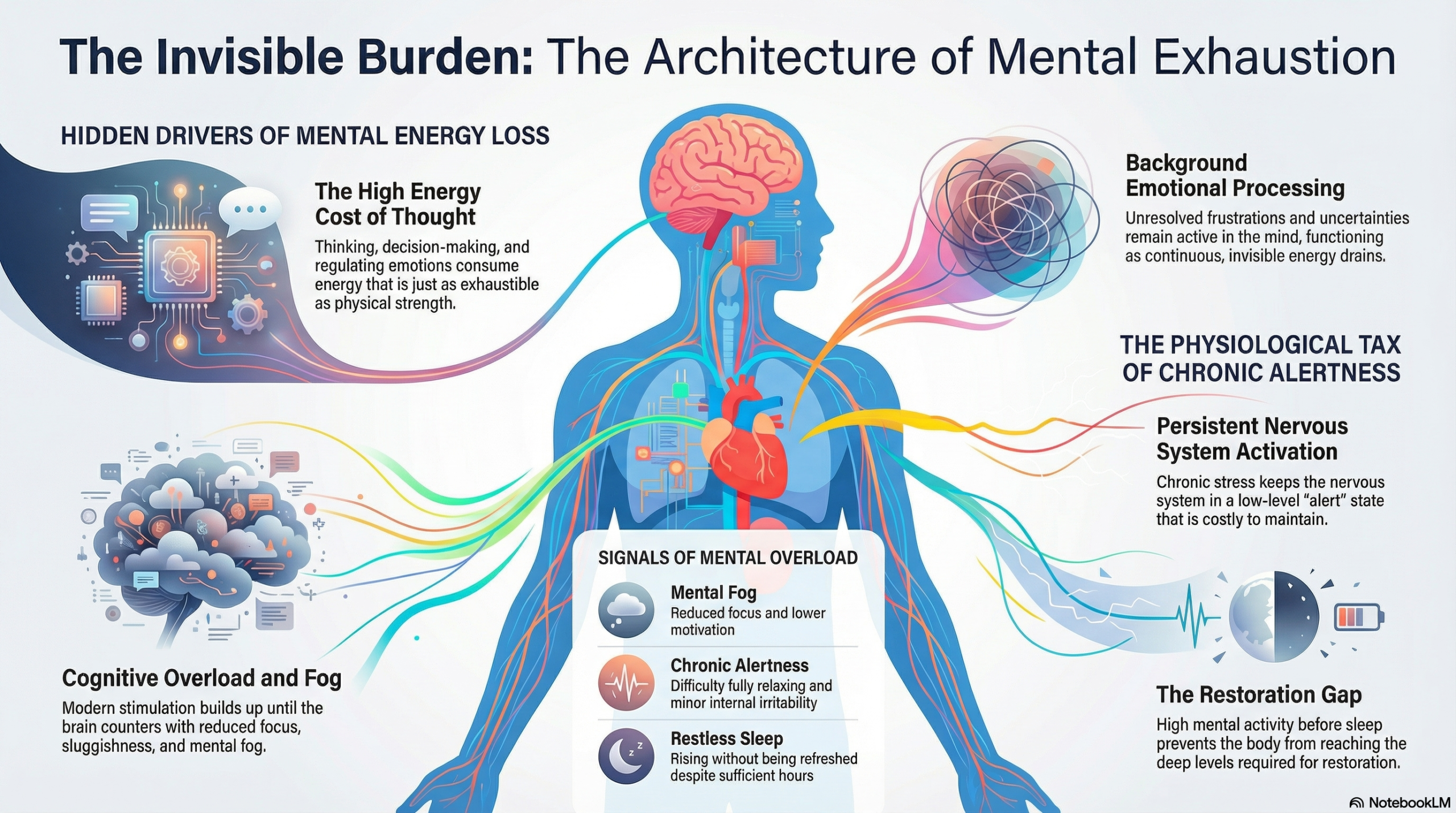
The brain itself, however, is among the highest energy-consuming systems in the body.
When the mind is constantly involved in thinking, watching, controlling emotions, foreseeing consequences, etc., it consumes energy that is not so evident but just as exhaustible.
This includes:
Each of these processes can be small individually.
However, they are seldom isolated.
They intersect, overlay, and repeat, sometimes unconsciously.
And with time, this brings about a kind of weariness that is not invariably alleviated by rest.
The body does not always get back on track right after the stress.
When a person faces constant stress (however minor and infrequent), the nervous system may adjust to the new situation by maintaining alertness at a minimum level.
Research shows that chronic stress can keep the nervous system in a low-level state of activation, even when there’s no immediate threat.
This is not necessarily anxiety.
It can feel quieter:
This condition is costly to maintain.
Thus, even when nothing is actively wrong, the body will still work in a manner that it requires to be ready.
In the long run, that chronic activation may seem like permanent fatigue.
Not all tiredness is due to work or duties. Part of it is in the form of what is unprocessed.
Feelings of disappointment, frustration, uncertainty, or even some form of dissatisfaction usually do not solve themselves unless dealt with.
Rather, they are left in the background.
The mind goes on re-experiencing them indirectly:
This constant processing is energy-consuming.
Not in a dramatic sense, but continuously.
Every day experience has come with some amount of mental stimulation that the brain was never intended to process.
Messages, decisions, comparisons, expectations, even slight ones, build up.
There is seldom a total stop.
The brain does not necessarily give an overload signal.
Rather than replying, “This is too much,” it tends to counter with sluggishness:
This may be experienced as fatigue, even when the body has not been physically exerted.
Sleep is important, but the quality is as important as the amount of time spent sleeping.
When a person is kept active in the mind before sleep, thinking, planning, or worrying, it may influence the process of deepening down to the restorative activities.
Equally, when the nervous system is kept on, the body will not relax.
Therefore, despite a complete night of sleep, it is possible to experience the following:
This may confuse, particularly where the surface sleep may be sufficient.

Constant mental tiredness comes in many familiar forms that we unknowingly ignore.
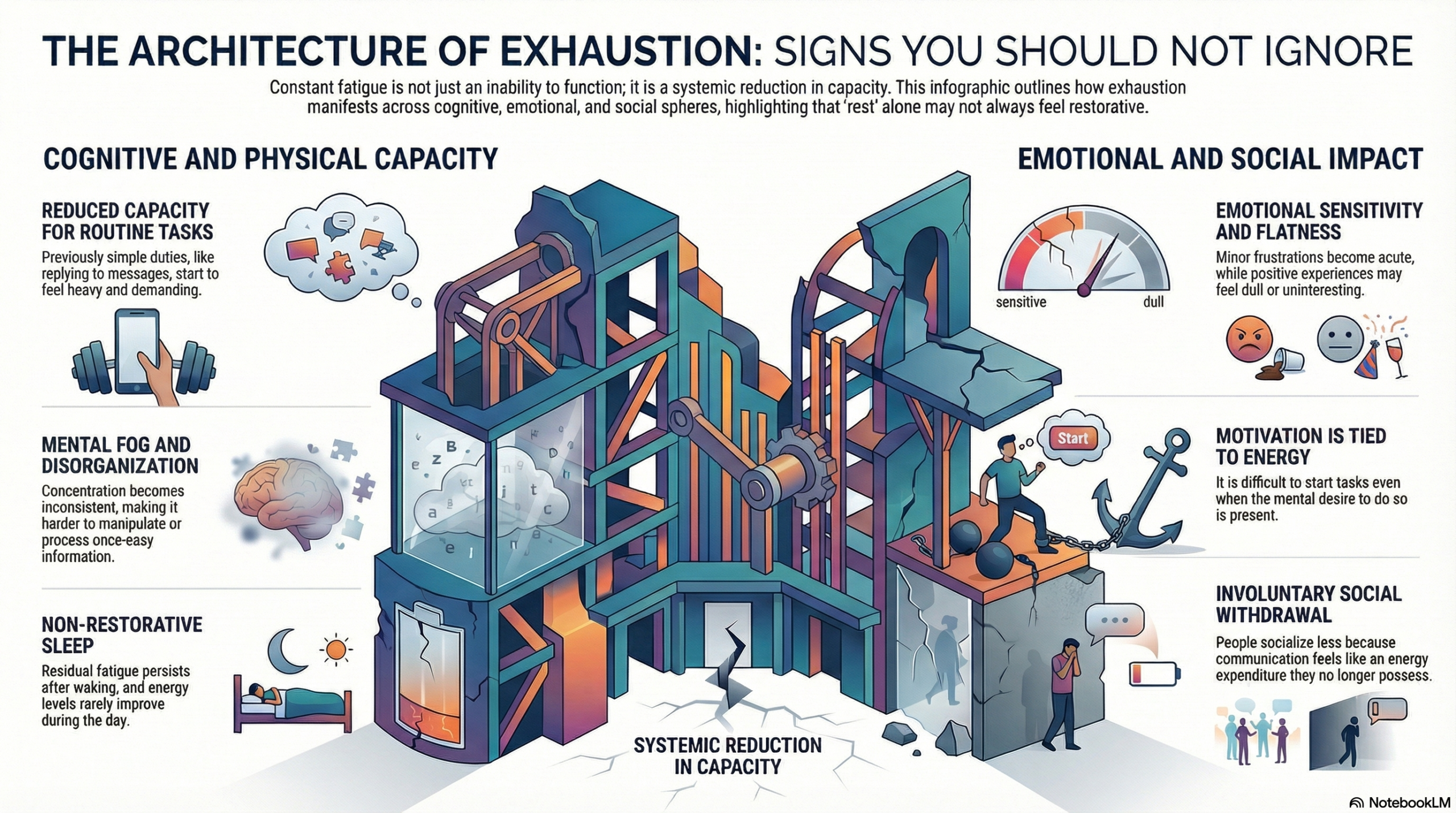
Activities that were previously routine start to weigh down:
It’s not an inability. It’s reduced capacity.
Concentration becomes inconsistent.
The mind can be perceived as slower or disorganised. It can be harder to manipulate information or accomplish once easy tasks.
Emotional experience is determined by energy levels.
When the system is tired:
It is not always emotionally dull.
Even after sleeping:
Sleep is something that occurs and does not entirely regenerate.
Motivation is usually confused with the mental one.
In fact, it is closely related to energy.
It is challenging to get things going when you are not well-rested, even when you want to.
5. Social Withdrawal
Communication can start becoming exhausting.
It is possible that people might end up socialising less and less, not by choice but because of the expenditure of energy they do not feel they possess.
When this pattern persists, its impacts become increasingly profound.
Fatigue is an assumed state of being and not a momentary occurrence.
There is less energy fluctuation and less fatigue.
People tend to start asking themselves the following:
This meaning is an additional burden to the mind.
Things that used to bring meaning can no longer be interesting.
Not that they have become worthless, but that the vigour of feeling them is diminished.
People might start to reduce their activities in order to save some energy.
In the long run, this may decrease the diversity and the spontaneity in everyday life.
Unless the underlying patterns are addressed, the state could progress to burnout.
Even not at once, but by accretion.
Such mental tiredness does not react favourably to force.
Attempting to break through usually makes one tired. Another strategy can prove to be more useful.
Fatigue might not be just another thing to beat.
It may represent the extent of what is being carried mentally, emotionally, or physically.
Certain types of strain do not manifest themselves instantly.
Realising the current mental or emotional work can provide little change in perceptions.
Even a short period of stimulation-free time can reduce cognitive load.
It is not about doing a certain thing but letting the system stop.
At a low level of energy, the same level of output may strain.
Some are comfortable accepting this rather than struggling against it constantly.
In case of persistent fatigue or a sense of it starting to impact everyday functioning, professional assistance can be used to investigate the underlying causes, and it can be good for your mental health.
The article is an educational one, and it should not replace professional mental health care.
When I think about my current state of mental health, most days, I am so drained that I am not able to get the strength to get out of bed.
It happens that some days the fatigue is not so great that nothing can be done.
You continue to pass through the day. You do what needs to be done. On the surface, it all appears… normal.
Something is slightly stilted, though, inwardly. Not broken. Just slower. Heavier.
I have long been familiar with this type of fatigue, yet unaware of it.
Not only in work or daily routine but also in everything that lies beneath it, the urgent necessity to drive, to demonstrate, and to continue even in the face of the silent opposition of the body or mind.
I used to believe that being tired implied being weak.
So, I did what I had been taught at an early age: I worked harder.
I trained harder. Ran more. Fought more. Attempted to be like that, to be a person who would not feel anything. Somebody who could endure pain and be indifferent to it. This was the feeling that I would not get tired the same way others did, provided I remained strong enough.
But that’s not how it works.
The body counts in some ways that the mind may not necessarily pick.
The stages were when I continued to go even when everything happened, the injuries, setbacks, failures, and pressure, and I believed that it was going to be just a matter of time before I was over. And sometimes it did.
But other times it had left something behind.
Something like a silent fatigue that could not be relieved by sleep. A heaviness that remained consistent even without any wrongdoing.
In retrospect, it is not only physical.
It was all piled on top of each other: the need to be something, the frustration of not being, and the continual struggle to keep things together, even when things did not feel that stable inside.
And that fatigue does not make itself obvious.
It just stays.
Even when life improves. Even when things start to make sense again.
You still have some of you that has not quite caught up.
I believe that is what makes it so ambiguous.
Since you can be doing better… and feel fatigued.
Not in a way that stops you.
But in a manner that you remember.
And that perhaps is the thing that ought to be known, not shoved aside.
Not fixed immediately.
Only now, thought made it no more of an object to struggle with.
Key Takeaways
Why do I feel tired all the time, even after rest?
This can be associated with mental fatigue, emotional tension or continuous stimulation of the nervous system and not sleep deprivation.
Is it anxiety or stress that makes one always feel fatigued?
Yes. Anxiety and stress may make the body active and this dispenses energy in the long run.
Is this the same as burnout?
Constant exhaustion may be a primary or a continuing component of burnout, although not all fatigue is burnout.
What is wrong with me that I am unmotivated and tired?
Motivation is prone to the influence of low energy. It can be indicative of poor capacity and not of poor interest.
When should I seek help?
In case fatigue is chronic, progressive, or disruptive to everyday life, it can be useful to consult a professional.
Tiredness has been regarded as a simple phenomenon, a phenomenon that is supposed to clear away after the body has had its share of rest.
Not every fatigue is patterned that way.
It even persists sometimes in forms that are not readily apparent. It is a legacy of what has been transported over the years, especially in the mental, emotional, and physical sense, which is not always known. It is not only active but also piled up.
Such exhaustion might not be easy to describe, even to a person. It does not necessarily disrupt life in blatant ways. Rather, it is a silent force that predetermines the feeling of things, the extent of effort needed, the degree of presence, and the amount of energy left at the end of the day.
It is not an understanding that eliminates fatigue.
But it alters the manner of its interpretation.
So, this blog will help you find the answer to the question, “Why do I feel tired all the time?”
It softens the disposition to reduce it to an individual failure. It gives room to view it as a reaction, rather than a weakness.
And occasionally, it is that shift in perception when one starts to feel a bit lighter.
This is the reason why Remnival exists.
Not to give fast solutions, not to implement change without realising it. The very name is an expression of a silent thought—to pause, to look inward, to make sense of what has been carried without rushing to correct it.
It is a place of experiences that are hard to describe but very familiar. A place where ideas can be slackened, called, and comprehended thoughtfully.
Because not everything that feels heavy needs to be fixed immediately.
Some things simply need to be understood first.
Thank you for reading my article. If you think my blog helped you, please read.
Why Your Mind Won’t Slow Down (Even When Nothing Is Wrong) – Explained

Why Your Brain Replays Conversations at Night: Understanding Nighttime Overthinking and Anxiety Have you ever thought of why your brain replays conversations at night, mostly

Discover the physical symptoms of anxiety, from muscle tension to fatigue, and learn how anxiety affects your body even when your mind feels calm.

Why Your Mind Won’t Quiet Down? Have you ever wondered why your mind won’t quiet down when nothing is actually wrong? Ever felt the bombardment

Why do I feel tired all the time even after rest? Discover the hidden causes of mental and emotional fatigue and how it affects your energy.

Thinking helps you move forward. Overthinking keeps you stuck. Learn the real difference between thinking and overthinking, and how to recognize when your mind crosses the line.

Why your mind won’t slow down even when nothing is wrong. Learn the real psychological reasons behind overthinking and how to calm a busy mind