What Is the Difference Between Thinking and Overthinking?
The act of thinking is usually considered good in itself. It is linked to rationality, astuteness, and problem-solving.
The difference between thinking and overthinking is that most people are encouraged to “think things through,” to reflect before acting, and to consider consequences carefully. In many contexts, this is reasonable.
This is where thinking quietly turns into overthinking — and most people don’t notice when it happens.
But there is a less dramatic experience that starts to dissolve that line—when it stops being helpful to think, but still, it does.
It does not necessarily seem dramatised or intense. It may often seem like reiterating the same thought without getting to anything different. It is similar to remaining psychologically engaged after a situation has been over. It may occur during normal times, when one is walking, lying in bed, or sitting in quietness, when nothing outside is requiring attention.
There is a slight shift at some point. The process ceases to be thinking and becomes something.
This is not necessarily apparent internally. Each of them is a mental activity. They can all be analysis, reflection, or planning. However, there is a change in the quality of the experience.
The distinction between thinking and overthinking lies not in naming behaviour but in identifying patterns. It helps clarify why the mind sometimes feels useful and at other times feels difficult to step away from—even when nothing is clearly wrong.
Thinking is often treated as an unquestioned good. It is associated with clarity, intelligence, and problem-solving.
But there is a quieter experience that begins to blur that boundary — when thinking no longer feels helpful, yet it continues.
It does not always appear intense or dramatic. Often, it looks like going over the same idea repeatedly without arriving at anything new. It feels like staying mentally occupied long after a situation has passed. It can happen in ordinary moments — while walking, lying in bed, or sitting in silence — when nothing external is demanding attention.
At some point, a subtle shift occurs. The process stops feeling like thinking and starts feeling like something else.
This distinction is not always obvious from the inside. Both involve mental activity. Both may involve analysis, reflection, or planning. But the quality of the experience changes.
Understanding the difference between thinking and overthinking is less about labelling behaviour and more about recognising patterns. It helps clarify why the mind sometimes feels useful and at other times feels difficult to step away from—even when nothing is clearly wrong.
Thinking helps you reach clarity and decisions.
Overthinking keeps you stuck in repetitive thoughts without resolution.
The primary difference between thinking and overthinking is that thinking leads to clarity or decisions, while overthinking involves repetitive thoughts that do not resolve and often increase mental fatigue.
Why Overthinking Happen (Psychological Explanation)
Before we understand why overthinking happens, we need to understand the difference between thinking and overthinking.
1. Thinking Serves Resolution. Overthinking Services and Uncertainty.
Fundamentally, thought is directed at motion. It is more inclined toward questioning the consideration of a certain conclusion; however, that might not be perfect.
On its part, overthinking is more likely to go around the uncertainty than traverse it.
This distinction between thinking and overthinking is commonly associated with the way the brain deals with ambiguity. Thinking can systematise information and reach a conclusion when the situation is clear. However, in the case of something that seems uncertain, be it emotional, social, or internal, the brain can process it to alleviate that unpleasant sensation.
It is at this point that the change starts.
Instead of:
“What should I do?” – decision
It becomes:
“What if I’m wrong?” – reconsideration – suspicion – perseverance.
The objective remains resolution, and the process no longer generates it.
2. The Role of Cognitive Loops
Repetitive cognitive loops are closely related to overthinking.
These loops are not random. They are normally pegged to something unfinished:
- A conversation that felt unclear
- A decision that carries risk
- An emotion that has not been fully processed
The brain goes back to these points not because they are crucial to the present, but because they are not finished.
This tendency has been termed, in cognitive psychology, the mind’s effort to close open loops. But when the loop is not practical but emotional, it cannot be bridged by thinking.
So, the loop continues.
“Psychology research suggests that the brain tends to revisit unresolved thoughts in an attempt to create closure.” Basically, this leads to depression.
3. Emotional Discomfort Drives Mental Repetition
One of the fundamental distinctions between thinking and overthinking is what drives them. Information tends to control the way a person thinks. The emotion is usually directed toward overthinking, especially discomfort which is barely noticeable. This uneasiness is not so obvious. It may appear as:
- Slight unease
- Lingering doubt
- A sense that something isn’t quite settled
Rather than directly experiencing the feeling, the mind tries to interpret it.
This creates a familiar pattern:
- feeling → thought → more feeling → more thought
Over time, the thought becomes a method of operating on the feeling, though this hardly ever resolves it.
4. The Nervous System’s Influence
There is no activity in the mind without the body. To some extent, even in the absence of conscious stress, when the nervous system is a little active, it can establish a baseline level of alertness. This condition causes the mind to scan, evaluate and predict more.
In this state:
- thinking becomes faster
- attention becomes more internally focused
- the mind becomes less willing to “let go” of unresolved topics
It is the reason why overthinking frequently occurs during externally quiet times. There is still a possibility that the body is still carrying an activation that even the mind is completing, that there is a need to remain active.
5. Control and the Illusion of Preparedness
Overthinking has a certain silent connotation: that the more one thinks, the better it will work out. This assumption is not entirely baseless. In other cases, mistakes are avoided by taking time to think.
But over time, the association can become exaggerated:
- thinking more = being safer
- thinking more = being prepared
- thinking more = avoiding regret
Consequently, it may seem dangerous to halt the thinking once it is no longer useful.

Thinking vs Overthinking: Key Differences
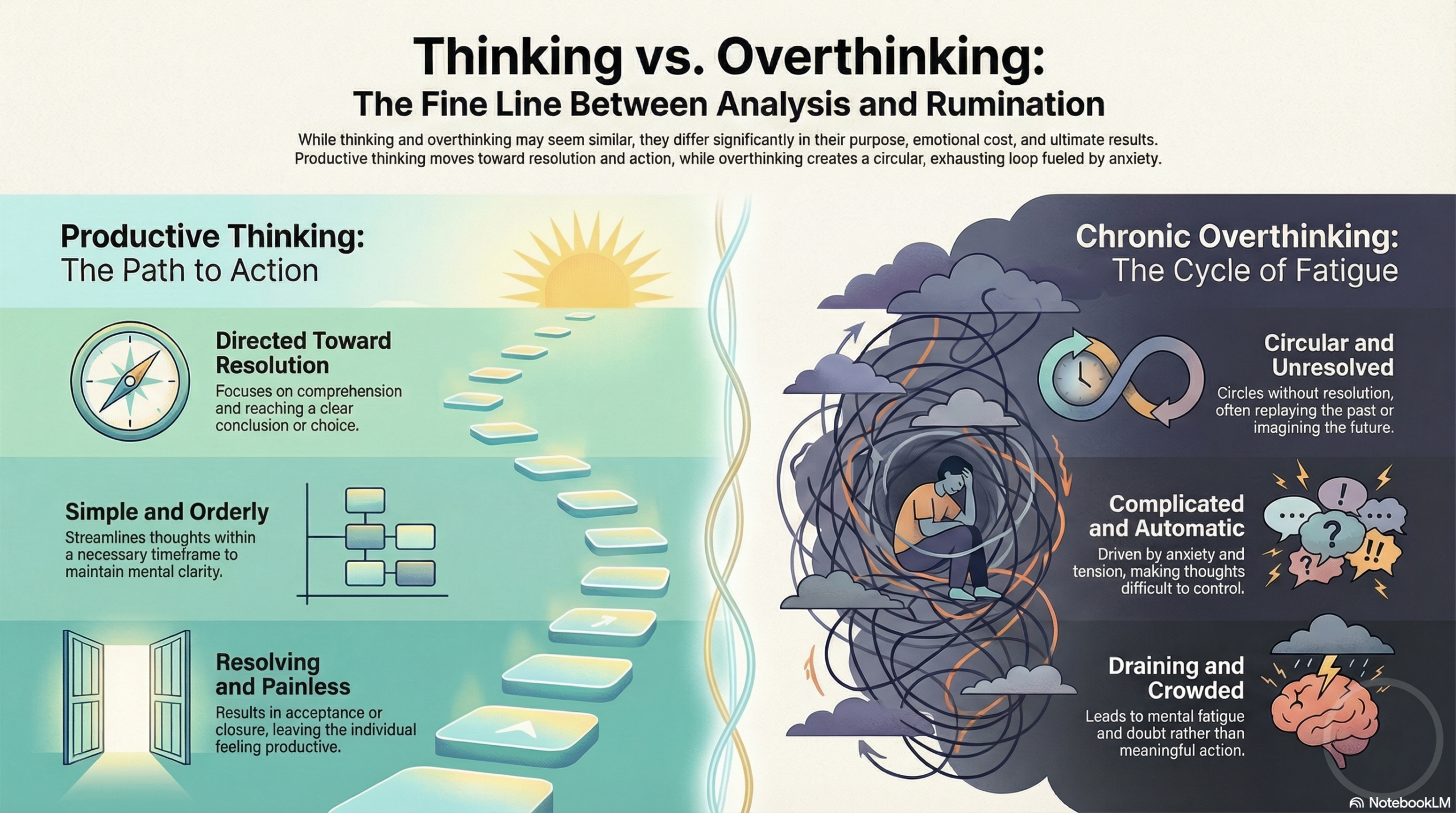
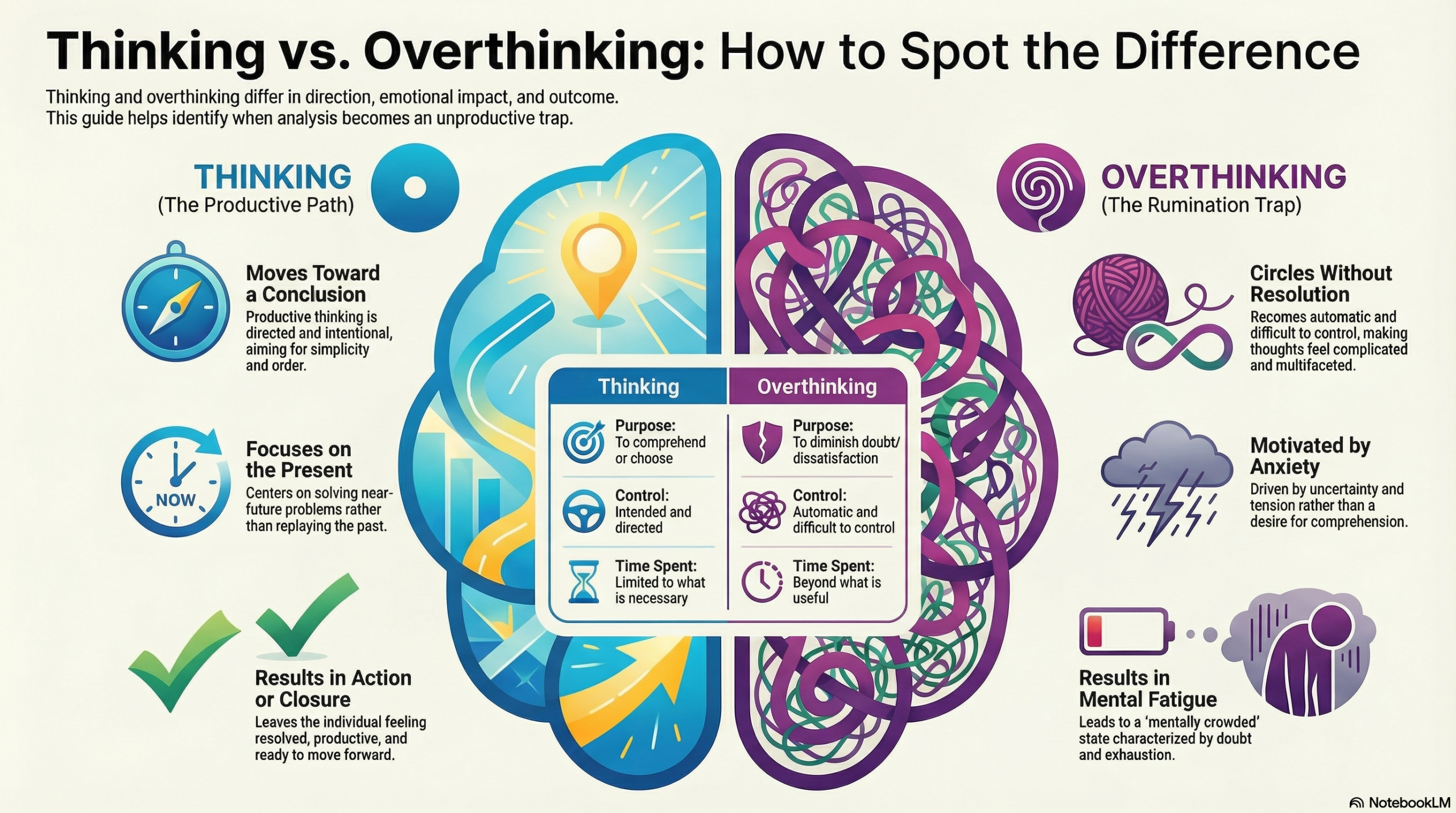
The difference between thinking and overthinking is sometimes subtle, yet the distinction can be made more readily by comparing each process in terms of their feel, operations, and impact on you in the long run. Here’s a clear comparison of thinking vs overthinking:
Aspect | Thinking | Overthinking |
Purpose | To comprehend or make a choice | To diminish doubts or dissatisfaction. |
Direction | Moves toward a conclusion | Circles without reaching a resolution |
Emotional State | Relatively painless or concentrated | Frequently motivated by anxiety, uncertainty, and tension. |
Clarity | Makes thoughts simple and orderly | Makes thoughts complicated and multifaceted. |
Control | Intended and directed | Difficult to control and automatic. |
Time Spent | Limited to the necessary one | Beyond the usefulness. |
Outcome | Results in action, acceptance or closure | Results in fatigue, doubt or repetition |
Focus | Present or near-future problem-solving | Past replaying or future imagining |
Mental Impact | Feels productive or resolving | Feels draining and mentally crowded |
A Subtle but Important Distinction
Thinking usually feels like moving through something.
Overthinking often feels like staying inside it.
The meanings of the thoughts can appear quite similar on the surface, so it is easy to overlook the differences. However, the inner experience is likely to change, between clarity and tension, direction and repetition. This change is hardly noticed by many people. The mind starts with a sensible question, and somewhere in the process, it finds a pause and starts reiterating.
Recognising that transition — not perfectly, but gradually — is often where awareness begins.
How It Shows Up in Daily Life
The difference between thinking and overthinking can be more easily seen in day-to-day life.
1. Thinking Feels Finite. Overthinking Feels Ongoing.
An individual may contemplate a choice, consider alternatives, and make a decision. Even when there is a feeling of incompletion, there is a feeling of completeness. It is not the sense that overthinking offers.
Instead, the same decision may be revisited repeatedly:
- Reconsidering the same factors
- Imagining different outcomes
- Questioning the decision after it has been made
There is no clear endpoint.
2. Thinking Clarifies. Overthinking Complicates.
Thinking tends to simplify. It systematises information into what is more comprehensible.
Quite the reverse is the case with overthinking.
Details multiply. Possibilities expand. Minor doubts become even greater.
A question as simple as it is can be made complicated:
- Not just “What should I say?”
- But “How will it be received?”
- “What does it imply about me?”
- “What if it changes the dynamic?”
The initial question is made more difficult to answer.
3. Thinking Is Intentional. Overthinking Is Automatic.
The thought process normally starts off with a decision, although it may be preoccupied.
Overthinking usually has no intended purpose.
One thought is shown and then proceeds on without conscious guidance.
Several steps have already taken place before the realisation of the same.
This is an automatic quality, one of the reasons why it would be hard to interrupt.
4. Thinking Respects Time. Overthinking Expands It.
The thoughts are likely to remain within the scope of relevance.
The overthinking spans through time:
- Revisiting past events
- Projecting into future scenarios
- Connecting unrelated moments
This gives the feeling of overcrowding of minds; various timelines intersect.
5. Thinking Coexists with Presence. Overthinking Pulls Away from It.
One can think and be in the present at the same time.
The overthinking condition tends to divert the mind inwards, to the point where external experiences become secondary.
Part of the conversation can be followed.
Activities can be done without complete participation.
The mind remains elsewhere.
Subtle Consequences Over Time of Thinking vs Overthinking
The difference between overthinking and thinking cannot be huge in a single situation, but it becomes more considerable over time.
1. Mental Fatigue That Feels Disproportionate
Overthinking is a waste of thought that yields no answer.
This brings about a type of fatigue which is not easy to explain since it is not associated with apparent effort.
Individuals might experience exhaustion at the end of non-objectively challenging days.
2. Reduced Confidence in Decisions
When decisions have to be re-estimated a few times, it is possible to start to distrust your judgment.
Even sensible decisions can be uncertain after a long period of thought.
This can lead to:
- Hesitation
- Second-guessing
- Avoidance of decisions altogether
3. Difficulty Experiencing Completion
Overthinking is a factor that prevents the feeling of having something done.
The mind might go back to an action even after it has been done.
This complicates the process of moving on.
4. Increased Sensitivity to Minor Details
Once the mind gets used to thinking deeply, even minor details can start to seem meaningful.
This is more evident in the social context, where neutral interactions can be understood in various ways.
5. Gradual Withdrawal from Mental Rest
Rest must have a certain amount of mental silence.
Stillness is strange or uncomfortable when overthinking.
Therefore, they might start evading it not intentionally, but after being constantly distracted
How to Stop Overthinking (Simple Steps)
The goal is not to eliminate thinking, but to recognise when it shifts into a different pattern.
1. Noticing the Shift in Quality
Among the more useful ones is not the amount you are thinking, but the feeling.
- Is the thinking moving somewhere?
- Or is it repeating without change?
This awareness usually comes out slowly, yet it leaves a point of decision.
2. Allowing Some Uncertainty to Remain
Overthinking usually tries to eliminate any uncertainty. Practically, this is hardly ever possible.
It might be possible to leave a few questions unanswered so that further analysis becomes unnecessary.
3. Separating Thought from Urgency
Not every thought requires immediate attention.
Whenever thoughts feel urgent, it may be a good idea to take a break and think it through to see whether one really needs to take action.
It is the feeling that is often urgent, rather than the situation.
4. Returning Attention Gently
Instead of letting the mind come to a halt, it is possible to divert attention to the present moment.
This is not the removal of thoughts but the alteration of the degree of interaction with them.
5. Writing to Create Distance
Turning thoughts into words without trying to make them a solution can diminish their intensity.
Patterns that are not easily visible internally are frequently brought out by externalising.
6. Considering Support When Needed
Once you feel you are constantly overthinking and this is persistent, it can be beneficial to discuss it with a mental health professional.
Knowledge of the underlying patterns can help make the experience less automatic.
This article is for educational purposes and is not a substitute for professional support.
Personal Reflection
When someone reaches a point where they no longer feel they are thinking, but rather that something is happening to them.
It is normally started by something small. A thought that makes sense. Something worth going over. You go with it a little, nearly unconsciously.
Then it stays.
Longer than it needs to. I am a constant overthinker, which I realised drains my energy most of the time.
I continue with my day as per my work schedule, but that one thing which started bothering me somehow continues replaying in my mind.
The reason for my overthinking is my past traumas, which get activated when I sense any pattern that hurt me before. I start replaying the situation and just try to reach any sort of conclusions which can break my mental health again.
Overthinking takes a lot of energy and can ruin any relationship. When you overthink, your mind is constantly pushing negative thoughts, which ruin your peace of mind and can cause more anxiety and stress.
As humans, we don’t have control over consequences. We can only control our actions.
Something that will become noticeable in the long run is not that there are thoughts.
It is because they do not stop at their usual ending.
There’s no natural pause. There is no silent spot on which the mind rests itself.
And the lack of that is subtle, yet it transforms the experience.
It is no longer thinking; it is not just thinking.
It is the sense of not being able to take the mind off even once.
Key Takeaways
- Thinking and overthinking differ in quality, not just quantity
- Thinking tends to lead toward resolution; overthinking tends to repeat
- Emotional discomfort often drives overthinking more than actual problems
- Overthinking can become automatic through habit and reinforcement
- The experience is influenced by both cognitive patterns and nervous system states
- Awareness of the pattern is often more useful than attempting to force change
Frequently Asked Questions
How can I tell if I’m overthinking or just thinking deeply?
Thinking profoundly tends to move toward clarity, even at a slow pace. Overthinking is apt for returning to the same arguments without any constructive conclusion.
Is overthinking always related to anxiety?
It does go hand in hand with anxiety, but it may also be a cognitive habit in itself.
Why do I overthink small things?
Attempts to settle trivial cases may stem from broader underlying concerns, particularly regarding uncertainty, identity, or social perception.
Can overthinking be reduced?
It may subside or reduce in intensity as time progresses, especially when underlying patterns contribute to its occurrence.
Does overthinking affect mental health long-term?
Overthinking may also lead to stress, sleeplessness, and emotional exhaustion, but these effects differ between people.
Closing
Thinking has always been part of how we try to make sense of things around us. It’s how we understand things, then prepare ourselves, and reflect. In many ways, it helps us feel a little balanced in a world that doesn’t always explain itself.
But overthinking doesn’t feel like that.
It is like the same process that lost track of where to stop. It has forgotten where to stop the brain from overthinking.
I have personally observed that this is neither loud nor overt. You do not get to the point where you suddenly realise you are overthinking. It just… keeps going. You think of one thing, then another, and then another, and eventually you no longer feel like you are leading it. You are merely in it, and you just have to wait it out.
And it usually doesn’t.
It is not the thoughts that change over time; it is just the way you start perceiving them. It is a moment of silence — it is not always distinct, not always continuous—when you start noticing this isn’t helping anymore.
The thinking does not stop at that moment. But it produces a little distance. And distances are sufficient sometimes. One of the lines that I tend to remember was said by Jon Kabat-Zinn:
“You can’t stop the waves, but you can learn to surf.”
Not in a motivational sense, but in a quieter way.
The mind can go on and do what it has been trained to do, revisiting, anticipating, and holding on a bit longer than is needed. However, being able to think of that pattern in a way that makes it different alters the correlation with it, even to some extent.
Not by forcing control. By simply not thinking that all of the thoughts should be pursued to the end.
We should understand that thoughts are just like waves. We can’t control them, but we can give them a direction.
If you have read my article on the difference between thinking and overthinking, thank you so much. If you think my blog helped you, please read-
Why Your Mind Won’t Slow Down (Even When Nothing Is Wrong) – Explained